Rule: Keep Vampires Out of the Sheep Pen.
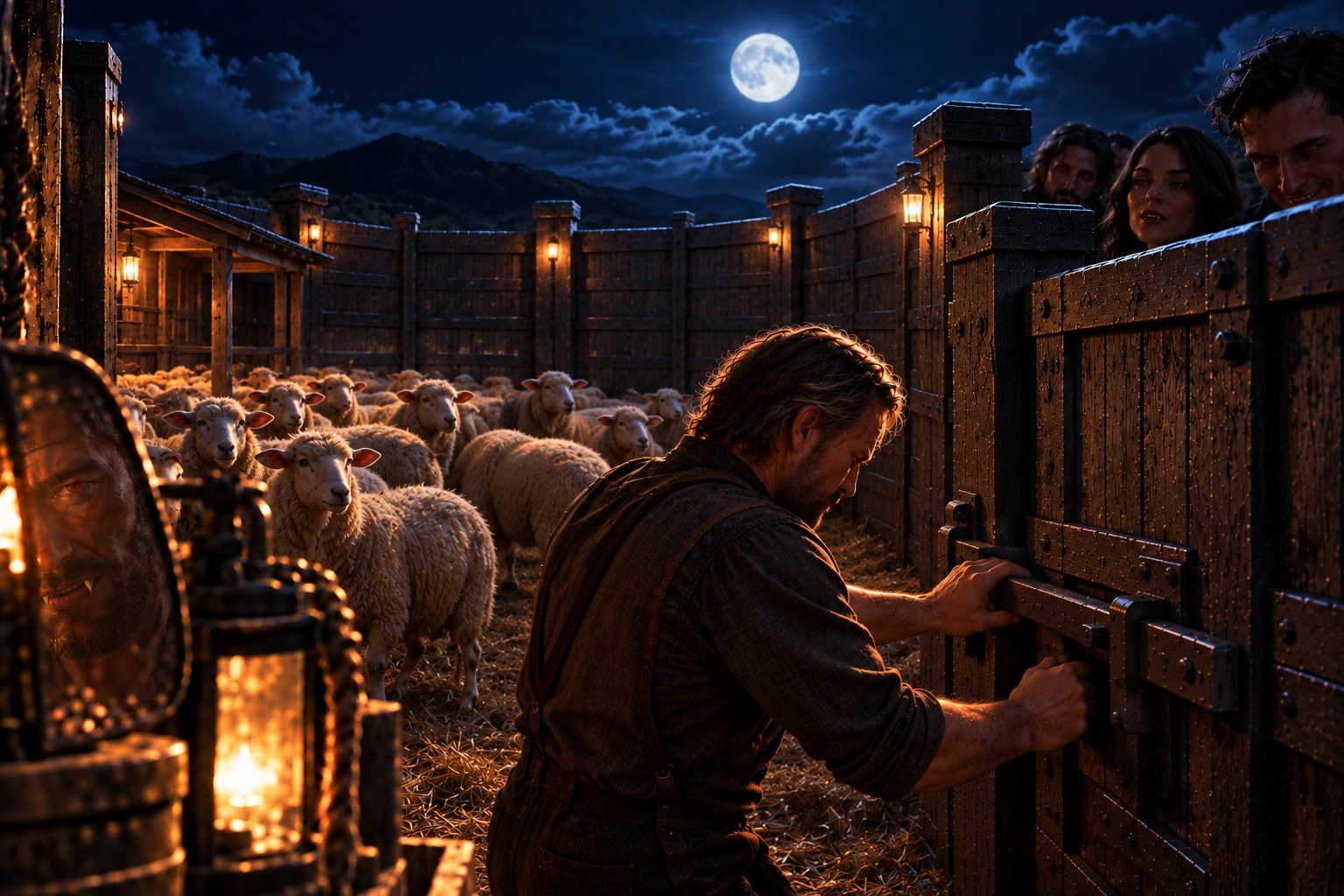
There is a seventeenth-century piece of vampire folklore that I find fascinating. It says that a vampire is not permitted to enter your home unless it is invited in. For such a terrifying creature, I have always found that to be a strange limitation.
Here you have an immortal, malevolent, grotesque, bloodthirsty monster capable of hunting you through the night, and apparently the thing standing between you and certain death is a doorway, your ability to say no, and the good sense to close the door.
In Sinners, Cornbread is a lovable character who provides some much-needed comic relief until an encounter with Remmick, a centuries-old vampire, turns him into something far more sinister. When he returns to his post as bouncer at Club Juke's, he discovers that he can no longer enter without being invited.
So he appeals to familiarity. He argues, reasons, and reminds them of who he is, making himself appear far less dangerous than he has become. After all, they know him. Why should they suddenly fear someone they trusted only a few moments earlier?
That is precisely what makes the vampire so dangerous. He uses the trust he once earned to conceal what he has become. The entire deception depends on convincing someone that opening the door is a good idea. Because the vampire doesn't need to break down the door. He only needs two words.
"Come in."
Once the invitation is given, everything changes. There is a truth buried in this piece of folklore. Those things that eventually drain the life out of you rarely begin by forcing their way through the door. They usually knock, and almost none of them introduce themselves honestly.
Instead, they offer something you want: friendship, relief, pleasure, belonging, opportunity, escape. Sometimes they offer exactly what you have been longing for. A relationship fills a place that needed filling. A drink takes the edge off a difficult day. An opportunity appears that looks so much like the future you imagined for yourself that saying no feels almost impossible.
There is, however, a truth we have to understand: The devil never offers evil in its true colors; he cloaks corruption in the language of virtue.
Obvious evil is not particularly tempting to the average person. We are far more willing to open the door when something destructive arrives disguised as something good. Pride calls itself confidence. Greed calls itself ambition. Lust calls itself love. Cowardice calls itself keeping the peace. Control calls itself protection. And betrayal, perhaps most dangerously, can disguise itself as loyalty.
In Dante's Inferno, he takes us on a descent through the nine circles of Hell, each representing increasingly severe forms of sin. What I find interesting is what he places at the very bottom. It isn't lust, greed, heresy, or violence, but betrayal.
In the ninth and deepest circle, he describes a frozen lake where those who betrayed family, friends, guests, and benefactors are imprisoned. At the very center sits Lucifer himself, trapped in ice with three faces, eternally chewing on Judas Iscariot, Brutus, and Cassius. The devil is surrounded by the very sin that brought him there: betrayal.
Dante understood something about the nature of evil. Betrayal requires something that violence, greed, gluttony, and anger do not necessarily require.
Trust.
You cannot betray someone who never trusted you in the first place. Betrayal takes something freely given, loyalty, affection, vulnerability, confidence, a secret, and turns it into an opportunity to wound the person who offered it.
And isn't that exactly how the vampire operates?
It does not need you to trust its teeth. It needs you to trust the face hiding them. Of course, not every vampire begins with the intention of betraying you. Some relationships genuinely begin well and become destructive over time. Sometimes there is no deliberate deception at all.
The defining characteristic of the vampire is not always its intention. It is what it consumes. And the frightening reality is that most of us are not the only ones living in the house. There are people behind you. Your spouse, children, friends, congregation, a classroom, a team, or people who trust your judgment enough that your decisions will affect their lives.
That is your sheep pen. Whatever has been entrusted into your care.
When you open the door, you are rarely the only person exposed to what walks through it. Your children live with what you invite into your home. Your spouse lives with what you invite into your marriage. The people you lead eventually feel the effects of the ambitions, insecurities, addictions, and appetites you refuse to examine.
We like to imagine that our choices belong to us alone, but the people closest to us live downstream from whatever we have allowed in or what we have allowed to master us.
I know something about letting vampires into the sheep pen.
Years ago, I moved my family across the country from Arizona to North Carolina to work at a church for a pastor named Benji. Benji had a growing, thriving church. He was held in high esteem and had been introduced to my wife and me through a mentor and friend.
This was not a small decision for my wife and me. I had a job I was good at, at a church I had grown up attending and dreamed of working at. We had people around us who were our best friends. All of our family lived in Arizona. Moving meant uprooting my wife and children, leaving familiarity and family behind, and attaching our future to a church, a job, and a man I believed I knew well enough to trust.
From where I was standing, the opportunity was good. Really good.The church was good. The pay was good. The title was good. The staff I would work with was good. The ministry was bigger.
There was something exciting about moving, and if I am truthful, there was something exciting about being the kind of person who would move his family across the country for ministry. I could tell people we were following the Lord. I believed that we were.
In saying that, I do not want to retell the story of my younger self simply because I know the ending. I prayed. We talked about it. I truly believed we were stepping into something God was leading us toward. But time has a way of forcing you to admit motives you were unwilling to acknowledge.
Because faith wasn't the only thing in the room when we made that decision. Ambition was there too. So were money, recognition, and the excitement of doing something that felt significant. I saw the opportunity, and my eyes got wide.
And Benji, at least the part of him he allowed others to know, made the opportunity easier to trust. He presented himself as a certain kind of man. Part of what I believed I was seeing was a pastor of integrity and humility, a man with a strong family and a strong marriage. Others believed that too. That mattered because I was not merely accepting employment from him. I was moving my family to be under his leadership.
However, shortly after joining the staff, that picture began to change. There were whispered stories about staff members who disagreed with him and were quickly shown the door. Questions and investigations surrounding financial mismanagement, an exorbitant lifestyle, domineering leadership, and a sense of entitlement that everyone must call him "Pastor Benji." A kind of unquestioned submission and loyalty was expected from the staff.
But the biggest change was still coming. In August of 2020, Benji gathered the church leadership together and told us that he and his wife were separating, with hopes of restoration. They eventually divorced. But don't worry. After a few weeks away from the church, he would return more focused and determined than ever to lead this movement forward.
The announcement was a shock to everyone. Directly after the meeting, he pulled me aside and told me something that changed the way I understood my decision to move, and my view of him. He said he had wanted to tell me during the interview process that he and his wife were already discussing separation. He wanted to warn my family while we were praying through the decision, but he believed there was still a chance they would stay together.
So he didn't tell me. I remember thinking that he should have told me the truth.
Not because a struggling marriage makes someone a bad pastor or a bad person. Marriages struggle. The problem was that this information belonged in the room while my wife and I were making a decision that would change our family's life. He had information that could have changed our decision, and he withheld it. Had I known, I would not have gone. I felt betrayed. Trust was broken, and the vampire came into focus.
What followed made that realization more painful.
We found ourselves in North Carolina, separated from our family during the pandemic. My wife became sick after exposure to black mold, an illness with aftereffects we are still dealing with to this day. I had walked away from a job I was good at, where life change was evident and fruit was growing. The thing we had moved toward was turning out to be something that was draining the life out of us. Emotionally, physically, and spiritually. That was the beginning of the erosion of my trust in pastors and the church.
For a long time, I could tell that story rather simply.
Benji was the vampire.
Something significant had been kept from me. I had been shown enough to want to invite him in without being shown the whole truth. I had failed to protect my sheep pen. There is truth in that version of the story. But it isn't the whole truth. Because Benji wasn't the only vampire in North Carolina.
I brought one with me.
My ambition was feeding too. My ego was feeding. There was a part of me that liked the title, liked the money, liked the opportunity, and liked what making that kind of move said about me.
Most dangerously, I had learned enough Christian language to make all of those things sound holy. We were following the Lord! Maybe we were.
But I have lived long enough now to know that two things can be true at once. You can genuinely believe you are following God while also being attracted to what the decision gives your ego. Faith and ambition can occupy the same heart. Obedience and self-interest can sit at the same table, and sometimes they become so intertwined that you cannot tell which one is speaking until years later, when the damage is already done.
That doesn't excuse what Benji withheld from me, how he manipulated his staff and church, or the emotional, financial, and spiritual abuse others experienced under his leadership.
But it has forced me to ask why I was so ready to invite the vampire in. I wanted what was standing on the other side badly enough that I wasn't examining the invitation as carefully as I should have been.
Some of what eventually drained my family did not have to trick its way past me, because part of me was already saying "Come in" before the door had opened all the way. And the worst part? My family was standing behind me. That is the part I have to live with.
My wife and children experienced consequences from an invitation they had trusted me to evaluate. The sheep were already inside the pen, and when I opened the door, what came through it did not only feed on me.
And that is why vampires are not always people.
Sometimes the vampire is ambition, opportunity, or the need to be important. Sometimes it is alcohol, drugs, pornography, gambling, shopping, or food. It can be the video game you began playing for fifteen minutes that eventually sucks time away from your family. It can be the phone you reach for without consciously deciding to reach for it. It can be work, money, success, resentment, approval, ministry, politics, religion, or the need to be admired.
And maybe this is an important distinction in all of this:
The vampire does not always have to be something inherently bad.
Think about the sun. Sunlight is good for us. We need it. But stay exposed long enough, and the same sun that warmed you can burn you. The fact that you got burned doesn't mean the sun is evil. It means something good can still harm you when your relationship to it becomes disordered. And we have a remarkable ability to remember the warmth long after we have started to burn.
That is what makes these vampires difficult to recognize. We judge them by what they once gave us rather than what they are currently taking from us. A vampire rarely takes everything at once. If it did, the arrangement would become obvious. It feeds slowly enough that you adjust to the loss.
Another evening. Another hour staring at the screen. Another conversation you don't tell your spouse about. Another compromise you once promised yourself you would never make.Eventually, the abnormal becomes normal. Your life begins organizing itself around making sure the thing gets fed.
At first, you chose it because you wanted it. There was pleasure in it, relief, perhaps even something genuinely good. But what began as a choice became a pattern, the pattern became a habit, and somewhere along the way, the habit began making demands of its own. And this is where something rather disturbing begins to happen.
You start arranging your life around satisfying something you once believed existed for your enjoyment. Your time, your attention, your relationships, even your convictions begin adjusting to accommodate it. Things you once considered important become interruptions. Responsibilities become inconveniences. People who question the arrangement begin looking like obstacles.
And you can become remarkably skilled at justifying all of it.
You tell yourself you deserve it. You've worked hard. You need an escape. You can stop whenever you want. And perhaps you can. But you keep discovering reasons why today isn't the day. That is how mastery begins to reveal itself. Not necessarily through some dramatic collapse, but through the gradual loss of your ability to say no.
Because there is a considerable difference between wanting something and needing to obey the desire for it. You can enjoy something, even love something, without surrendering your freedom to it. But when the thought of going without it produces anxiety, resentment, anger, or a desperate need to justify yourself, you ought to pay attention.
Something has changed in the relationship. The thing that once served you is now being served by you. And perhaps the most frightening part is that you can continue calling the arrangement freedom because nobody is physically forcing you to participate. The invitation was given. The door is still open. You could leave whenever you wanted.
At least, that's what you keep telling yourself. But freedom cannot simply mean having permission to satisfy whatever desire happens to appear. If every appetite must be obeyed because you experience it, then you are not particularly free. You have become subject to the very thing you once invited into your life.
You have mistaken the voice giving the orders for your own. And eventually, the important question is no longer whether you want something. It is whether you can want it and still say no.
Dallas Willard spent much of his work thinking about this from the perspective of spiritual formation. The Christian life is not simply knowing what is right and periodically gathering enough willpower to do it. It is the gradual formation of our thoughts, bodies, habits, desires, relationships, and choices so that we become people capable of freely choosing what is good.
That matters because eventually the fence will fail. You cannot remove every temptation from your children's lives. You cannot prevent them from encountering every idea you disagree with. You cannot choose every friendship your spouse makes or stand beside your friends making sure they never open the wrong door.
Eventually, the external fence has to become internal character. The goal is not to create people who are terrified of everything outside the sheep pen. It is to form people capable of recognizing what deserves to come inside. And that becomes considerably harder when the vampire has a face you love.mSome relationships were genuinely good once.
Someone walked beside you through a difficult season, became part of your family, knew things about you few others knew, and stood beside you when other people disappeared.mNone of that has to have been false for what comes later to become unhealthy. A friendship can slowly become dependence, and dependence can become entitlement without either person recognizing exactly when the transition occurred.
The person who once wanted to be part of your life begins needing to be central to it. They need more access, information, and reassurance. Decisions made without them feel like rejection. Other friendships feel threatening. And sometimes the person doesn't even realize what they are doing.
They may genuinely be lonely, hurting, or afraid of abandonment. Their needs are real, and your empathy for them may be entirely justified. But empathy can become the very thing they feed on. You begin by helping because you care. Then you find yourself managing their emotions, anticipating their reactions, and rearranging your life to prevent another crisis.
Their need becomes an obligation you never agreed to, and your compassion becomes a resource they assume will always be available. Eventually, the cost begins to show up in you. You become exhausted, impatient, resentful, and emotionally withdrawn. The person who once wanted to help begins dreading the phone call.
And what's worse, that exhaustion follows you home. The people who should receive the best of your love begin receiving whatever is left after someone else has drained you. The vampire has not only consumed your empathy. It has begun changing the kind of person you are. And sometimes you participate in that arrangement because being needed feels good.
Being someone's first call, knowing the secrets, fixing the problem, providing the advice, hearing "I don't know what I would do without you" all of that can feel remarkably similar to love. You can become so accustomed to being someone's rescuer that some part of you needs them to remain wounded. Their healing threatens your role. Their independence feels like distance. Sometimes both people are feeding. One feeds on reassurance while the other feeds on being needed. One needs rescuing while the other needs to remain the rescuer. And both can call the arrangement love.
There is a moment in Twilight, and I cannot believe Twilight has become useful to this discussion, when Edward forces Bella to name what she has already figured out.
"Say it... out loud."
"Vampire."
It is melodramatic. Poorly written and poorly acted. Of course it is. It's Twilight. But underneath the teenage romance, the unnecessarily intense eye contact, and the horrible color scale is something psychologically important. Eventually, you have to name the thing for what it is.
We tend to soften the language surrounding things we do not want to confront. Control becomes concern. Possessiveness becomes loyalty. Dependency becomes closeness. Manipulation becomes a misunderstanding. Intrusion becomes helping. You get the picture. Accurate language is uncomfortable because accurate language requires action.
And the worst part about that scene in Twilight is that Bella already knows what Edward is. She knows he's a vampire. And she still wants him anyway.
Now enough Edward and Bella. Somebody get these VAMPIRES out of here.
But wanting the vampire is an accurate portrayal of how we operate. It is certainly an accurate portrayal of what I wanted before moving to North Carolina. We do not only remain trapped because we fail to recognize what is happening. Sometimes we see it clearly and still want what it gives us. And sometimes the reason we refuse to close the door isn't that we don't know what is standing on the other side.
It is that we cannot tolerate what closing it will cost us. That is especially true in relationships because history has weight. We remember who was there for us, what we survived together, how much we laughed, and who we were during that season of life. Those things are real. But history does not guarantee a future.
You can love someone, be grateful for what they meant to you, and still recognize that allowing them continued access to your life is destroying something you have a responsibility to protect.
Sometimes protecting your family means disappointing a friend. Sometimes it means refusing an opportunity you desperately wanted. Sometimes it means allowing someone to misunderstand your intentions because you are no longer willing to sacrifice the people entrusted to you in order to keep someone else satisfied. And sometimes it means confronting the part of yourself that enjoyed being needed, admired, or indispensable.
You cannot keep sacrificing your sanity, your marriage, your children, or your character simply because you remember when things were good. You have to uninvite the vampire.
But there is another possibility we have to consider, and it may be the most uncomfortable of them all.
In The Dark Knight, Harvey Dent says, "You either die a hero or you live long enough to see yourself become the villain." There is something disturbing about that observation when we begin seeing ourselves as protectors. A person can begin with the genuine desire to protect others and gradually become so consumed by that responsibility that protection turns into control.
The father who wants to keep his children safe begins demanding obedience rather than developing wisdom. The friend who wants to help becomes possessive. The pastor who wants to shepherd people begins needing their loyalty more than their growth. The person who once stood at the gate to protect the sheep can eventually become the thing they need protection from.
And this rule would be useless if it only gave me language for diagnosing everyone else. I can consume people too. My ambition can consume my family's time. My insecurity can consume another person's reassurance. My need to be right can consume someone's ability to disagree with me. My desire to protect can become control. I don't have to hate someone to feed on them.
Sometimes I may feed on them precisely because I love them and am terrified of what their freedom might mean for me. The people entrusted to us do not exist to sustain our identities. My children do not exist to prove that I am a good father. My wife does not exist to continually reassure me that I am worthy of love. My friends do not exist to make me feel necessary. And if the people in your care must remain weak, dependent, impressed, compliant, or afraid of disappointing you in order for you to feel secure, you are no longer merely guarding the sheep.
You are feeding on them.
And this is where Jesus gives the entire metaphor its proper direction. In John 10, Jesus calls himself the Good Shepherd and says the Good Shepherd lays down his life for the sheep.
Think about how completely opposite that is from the vampire. The vampire takes life from another in order to sustain itself. The Good Shepherd gives himself so another may live.
One consumes. The other sacrifices.
One needs continued access because access is how it survives. The other spends himself for the good of those entrusted to him. And that distinction reaches into parenting, marriage, friendship, and leadership.
The measure of my love for my children cannot be how desperately they need me, because part of loving them is preparing them for a life in which they increasingly do not.
The measure of my marriage cannot be whether my wife could survive without me. The question is whether our life together makes both of us more capable of becoming the people we ought to become. The measure of friendship cannot be how much access I have to another person's life, or how indispensable I have become to their happiness. Love cannot require another person to remain diminished so that I can feel significant.
Because the shepherd does not exist to be sustained by the sheep. He exists to care for them.
And that is why protecting the sheep pen cannot simply mean becoming suspicious of everyone outside it. It means learning what deserves access while remembering that you are capable of becoming the very thing the people you love need protection from.
I am still trying to figure that out. There are gates I should have closed sooner and probably others I closed too quickly. There have been things I allowed inside because I enjoyed what they gave me, and things I blamed for feeding on me without admitting how willingly I kept returning to feed them. There have been moments when I thought I was protecting people when perhaps I was controlling them, and moments when I avoided confrontation and called it grace because grace sounded considerably better than fear.
The goal cannot simply be better boundary enforcement. It has to be becoming a different kind of person. Someone capable of loving without possessing, helping without needing to become indispensable, holding conviction without fearing every disagreement, enjoying something without being mastered by it, and receiving love without demanding that another person continually prove it.The world will always contain things asking to come inside, and the answer cannot simply be to stop opening the door.
So love people. Trust people. Build friendships. Encounter ideas that challenge you. Play the game. Use the phone. Do meaningful work. Take opportunities. Risk being known.
Get into trouble, as the mom in The Sandlot would say. A life spent hiding from vampires would hardly be a life worth protecting.But pay attention to what happens after something enters.
Pay attention when enjoyment becomes necessity, when closeness becomes entitlement, when conviction becomes unquestionable allegiance, when helping becomes control, or when something that once added to your life requires the rest of your life to rearrange itself around keeping it satisfied. Pay attention to what you are becoming in the process.
Because sometimes the vampire is someone who has betrayed you. Sometimes it is something you once loved that has slowly gained mastery over you. Sometimes it is a relationship you know has become destructive, but you cannot bring yourself to end because you still remember what it once meant to you.And sometimes the vampire is looking back at you in the mirror.
Check the gate. Then check your own teeth.
You cannot keep feeding the vampire simply because you remember when it was your friend. And you cannot keep demanding that the people you love feed the parts of you that refuse to grow up, let go, or surrender control. Because you are not the only one living in the house.
There are people behind you who trust you, love you, and will live with what you invite inside long after the excitement of opening the door has disappeared.
Those are your sheep.
And protecting them means loving them more than you love the thing that once brought you happiness, belonging, purpose, or comfort. It means becoming the kind of person who can recognize when something is taking more life than it gives, even when you still want it, even when you once loved it, and even when closing the door will cost you something.
Because the responsibility of the shepherd is not merely to recognize the vampire standing outside the gate.
It is to recognize when something is already feeding on the flock, have the courage to drive a stake through its heart, and finally close the gate.
